

Classroom management for grades 6–8

Calm responses.
Clear routines.

I’m Marco, a math and science teacher. On Steady Classroom I share what I do when students interrupt, a class gets loud, or a routine stops working — and the exact words I use.

  • The exact words, not just the idea
  • Calm — without raising your voice
  • Something you can use in class tomorrow
The words you use
Name the next step, not the problem.
Not this“Stop talking!”
Say this“What should you be doing right now?”

A “what” question doesn’t push anyone onto the defensive. It hands the responsibility back to the student.

Marcomath & science teacher
What you’ll find here

Three moments that decide a period

Everything on this channel belongs to one of three moments: before the bell, in the middle of a disruption, and the sentence you say next.

1

Before the bell

Whoever owns the start owns the room. Wait for quiet before your first word, and practice routines until they run without an announcement — usually three rounds.

2

In the moment

Take away the stage. A pause instead of a louder voice, a quiet word at the desk instead of a call across the room, “we’ll talk after class” instead of a public argument.

3

The words you use

Name the next step, not the problem. Ask “what” instead of “why” — “why” almost always gets you an excuse.

One situation at a time: what to do, and what to say.

Try this week

Three strategies you can use tomorrow

None of them costs anything. All three come from my own classroom.

In the moment

The strategic pause

When the room starts getting restless, stop in the middle of your sentence — and wait.

What you do

Stop talking. Look calmly across the room and wait in silence until you have everyone’s attention again.

Why it works

Silence is often louder than any reminder. It says: I’m in charge of this time, and I won’t give it up to noise. The class learns fast that interruptions only make the wait longer.

The most common mistake: waiting means waiting. If you start talking again after three seconds, you’ve taught the class that your pause means nothing.
In the moment

The private whisper

A quiet, personal cue protects the student’s dignity and brings them back to the work.

Say this
Can you listen for a moment, please?instead of “Quiet!” across the room
What you do

Walk over quietly, make eye contact, keep your voice calm.

Why it works

It takes away the stage. Nobody has to defend themselves or save face in front of the class — which is what often makes things escalate.

Staying steady

The “later” principle

When a student challenges you, you decide when it gets talked about — not the moment.

Say this
We’ll talk about it after class.calmly, and then keep teaching
Why it works

It takes the heat out right away and takes away the audience. You stay in charge of the timing, and the conversation later is calmer for both of you.

Pro tip: write the name on a sticky note and put it on your desk where it can be seen. It says: I noticed, and we’ll deal with it at the right time.

There are more like these in the playbook →

The attitude behind it

Soft on the relationship.
Immovable on the structure.

Both at once — that’s the whole craft.

Relationship before method.

Once a student feels seen, the need to rebel goes away.

Disruptions are messages, not attacks.

The question isn’t “Whose fault is this?” It’s “What’s missing right now?”

Values over rules.

Rules say what’s not allowed. Values show who you want to be as a class.

The playbook

Everything in one place, ready to print

For when you want the whole system on your desk instead of in a video: every strategy on its own page, the words to say, and the pages you grab when a period is going sideways.

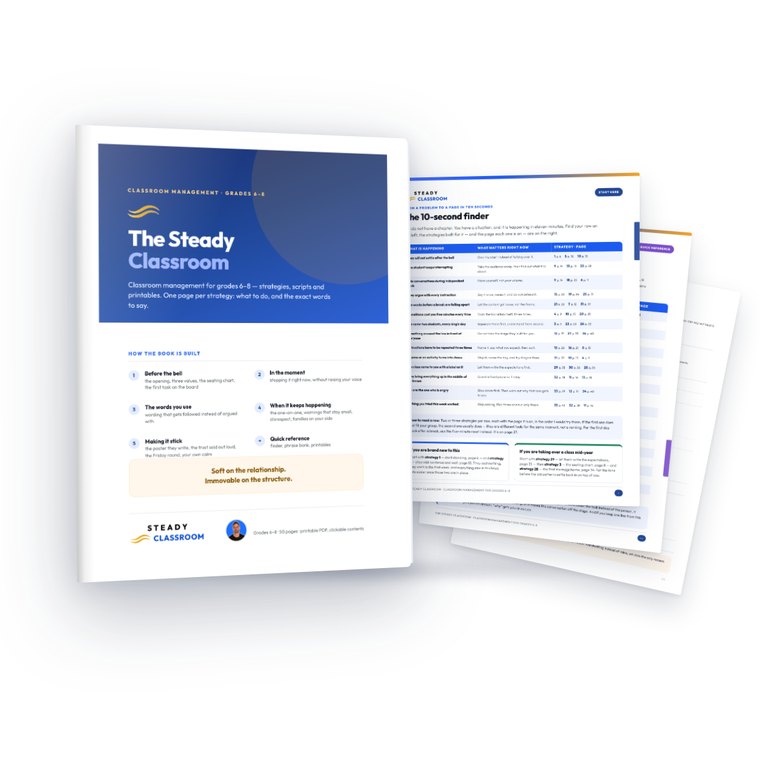
The Steady Classroom playbook: cover, the 10-second finder, the “Say this, not that” page and a printable
Teacher manual · printable PDF · 50 pages

The Steady Classroom

Classroom management for grades 6–8: strategies, scripts & printables

35 strategies, one page each: what to do, why it works, and the exact words to say — all of them from my own classroom and my videos.

  • A 10-second finder: from situation to page
  • A phrase bank and “Say this, not that”
  • Printables for your class, without a logo
  • US Letter, clickable table of contents
$9.50on Teachers Pay Teachers
View on TPT →
Marco, the teacher behind Steady Classroom
About

Hi, I’m Marco.

I’ve been a teacher for seven years. I started at a middle school in Bavaria, spent time observing classrooms in Finland, and now teach math and science at a German school in the Chicago area.

On Steady Classroom, I share what I do when students interrupt, a class gets loud, or a routine stops working: practical ideas, words you can use in your own classroom, and honest stories from my teaching in Germany and the U.S.

I also run KlassenFLOW, a German YouTube channel for teachers.

Write to me →
On YouTube

Watch it, then try it

One situation per video: what happens, what I do, and the sentence I say.

The first videos are on their way.

Subscribe now, and they’ll show up in your feed as soon as they’re live.

Subscribe
Questions

What teachers ask me

Is this for elementary school?

No. Everything here is written for grades 6–8: the examples, the wording, and the printables.

Where do the strategies come from?

From my own teaching — first at a middle school in Bavaria, now at a German school in the Chicago area. Everything here comes from my classroom and my videos.

Do I have to buy anything?

No. The videos are free. The playbook is for teachers who want it all in one place — printable, with the exact wording.

Can I print the pages for my class?

Yes, for your own classroom. One purchase covers one teacher; a colleague can add a license on TPT.

Can I tell you about my class?

Please do. If a situation keeps coming back and nothing works, write to me at steadyclassroom@gmail.com. I use what teachers tell me to make the next videos more useful.

Start with two things this week.

Wait for quiet before your first word. Use the strategic pause. Both cost nothing and work right away — everything else builds on them.